The Myth
Apollodorus 3.3.1
... But Glaucus, while he was yet a child, in chasing a mouse fell into a jar of honey and was drowned. On his disappearance Minos made a great search and consulted diviners as to how he should find him. The Curetes told him that in his herds he had a cow of three different colors, and that the man who could best describe that cow's color would also restore his son to him alive. So when the diviners were assembled, Polyidus, son of Coeranus, compared the color of the cow to the fruit of the bramble, and being compelled to seek for the child he found him by means of a sort of divination. But Minos declaring that he must recover him alive, he was shut up with the dead body. And while he was in great perplexity, he saw a serpent going towards the corpse. He threw a stone and killed it, fearing to be killed himself if any harm befell the body. But another serpent came, and, seeing the former one dead, departed, and then returned bringing a herb, and placed it on the whole body of the other; and no sooner was the herb so placed upon it than the dead serpent came to life. Surprised at this sight, Polyidus applied the same herb to the body of Glaucus and raised him from the dead.
Minos had now got back his son, but even so he did not suffer Polyidus to depart to Argos until he had taught Glaucus the art of divination. Polyidus taught him on compulsion, and when he was sailing away he bade Glaucus spit into his mouth. Glaucus did so and forgot the art of divination.
Hyginus’ Fabulae [136] CXXXVI. POLYIDUS
When Glaucus, son of Minos and Pasiphae, was playing ball, he fell into a jar full of honey. In the parents’ search, they made inquiry of Apollo about he boy. Apollo told them: A prodigy has been born for you. Whoever explains it will restore the child to you. Upon hearing this reply, Minos began inquiring from his people about the prodigy. They told him that a bullock had been born which changed colour three times a day, every four hours - first white, then red, then black. Minos then called together the augurs to explain the prodigy, and when no one was found who could do so, Polyidus, son of Coeranus, showed that the bullock was like a mulberry tree, for first its fruit is white, then red, and when ripe, black. Then Minos said to him: “According to the words of Apollo, you should be able to restore my son to me.” While Polyidus was observing omens, he saw an owl sitting over the wine-cellar and putting bees to flight. He interpreted the omen, and brought out the lifeless boy from the jar. Minos said to him: “You have found the body. Now restore life to it.” When Polyidus said this was impossible, Minos ordered him to be shut in a tomb with the boy, and a sword placed there. When they had been shut in, a snake suddenly made for the body of the boy, and Polyidus, judging the creature whished to devour the body, suddenly drew the sword and killed it. Another snake, seeking its mate, saw that it was dead, and came and brought a herb, and its touch restored life to the dead snake. Polyidus did the same. When they called out from within, a passerby reported it to Minos, who opened the tomb and found his son safe. He sent Polyidus many gifts back into his country.
Robert Graves’ The Greek Myths
90c. Glaucus, while still a child, was playing ball one day in the palace at Cnossus or, perhaps, chasing a mouse, when he suddenly disappeared. Minos and Pasiphae searched high and low but, being unable to find him, had recourse to the Delphic Oracle. They were informed that whoever could give the best simile for a recent portentous birth in Crete would find what was lost. Minos made enquiries and learned that a heifer-calf had been born among his herds which changed in color thrice a day - from white to red, and from red to black. He summoned his soothsayers to the palace, but none could think of a simile until Polyeidus the Argive, a descendant of Melampus, said: ‘This calf resembles nothing so much as a ripening blackberry [or mulberry].’ Minos at once commanded him to go in search of Glaucus.
d. Polyeidus wandered through the labyrinthine palace, until he came upon an owl sitting at the entrance to a cellar, frightening away a swarm of bees, and took this for an omen. Below in the cellar he found a great jar used for the storing of honey, and Glaucus drowned in it, head downwards. Minos, when this discovery was reported to him, consulted with with the Curetes, and followed their advice by telling Polyeidus: ‘Now that you have found my son’s body, you must restore him to life!’ Polyeidus protested that, not being Asclepius, he was incapable of raising the dead. ‘Ah, I know better,’ replied Minos. ‘You will be locked in a tomb with Glaucus’s body and a sword, and there you will remain until my orders have been obeyed!’
e. When Polyeidus grew accustomed to the darkness of the tomb he saw a serpent, approaching the boy’s corpse and, seizing his sword, killed it. Presently another serpent, gliding up, and finding that its mate was dead, retired, but came back shortly with a magic herb in its mouth, which it laid on the dead body. Slowly the serpent came to life again.
f. Polyeidus was astounded, but had the presence of mind to apply the same herb to the body of Glaucus, and with the same happy result. He and Glaucus then shouted loudly for help, until a passer-by heard them and ran to summon Minos, who was overjoyed when he opened the tomb and found his son alive. He loaded Polyeidus with gifts, but would not let him return to Argos until he had taught Glaucus the art of divination. Polyeidus unwillingly obeyed, and when he was about to sail home, told Glaucus: ‘Boy, spit into my open mouth!’ Glaucus did so, and immediately forgot all that he had learned.
g. Later, Glaucus led an expedition westward, and demanded a kingdom from the Italians; but they despised him for failing to be so great a man as his father; however, he introduced the Cretan military girdle and shield into Italy, and thus earned the name Labicus, which means ‘girdled’.
Daniel Ogden’s Greek and Roman Necromancy
The Greeks used honey as a general preservative, and in particular made use of it when they wished to embalm their dead... Other Greek traditions preserve a link between honey, resurrection, and necromancy. Thus the Cretan king Minos's son Glaucus disappeared and died by falling into a pot of honey. Polyidus ("the much seeing"), commissioned by the king to find him was led to the jar by a dream. Minos then ordered Polyidus to restore the boy to life, and, when he could not, had him immured with him in his tomb. A snake then brought and demonstrated a magic herb, which Polyidus used to resurrect Glaucus. The honey was evidently integral to the resurrection, for the summary proverb said, "Glaucus drank honey and rose again."
The Mushroom
Terrence McKenna’s Food of the Gods
Let us attempt to analyze this peculiar story. First of all, it is necessary to comment on the significance of the names of the two main characters: Polyidos is clearly “the man-who-has-many-ideas,” and Glaukos simply means “blue-gray”. The meaning of Glaukos was for me the entry point into the intention of the myth. It is well known among mycologists that the flesh of Stopharia cubensis and other psilocybin mushrooms has the property of staining a bluish color when bruised or broken. This blue staining is an enzymatic reaction and a fairly reliable indicator of psilocybin. Glaukos, the youth who is preserved in the jar of honey, seems symbolic of the mushroom itself…
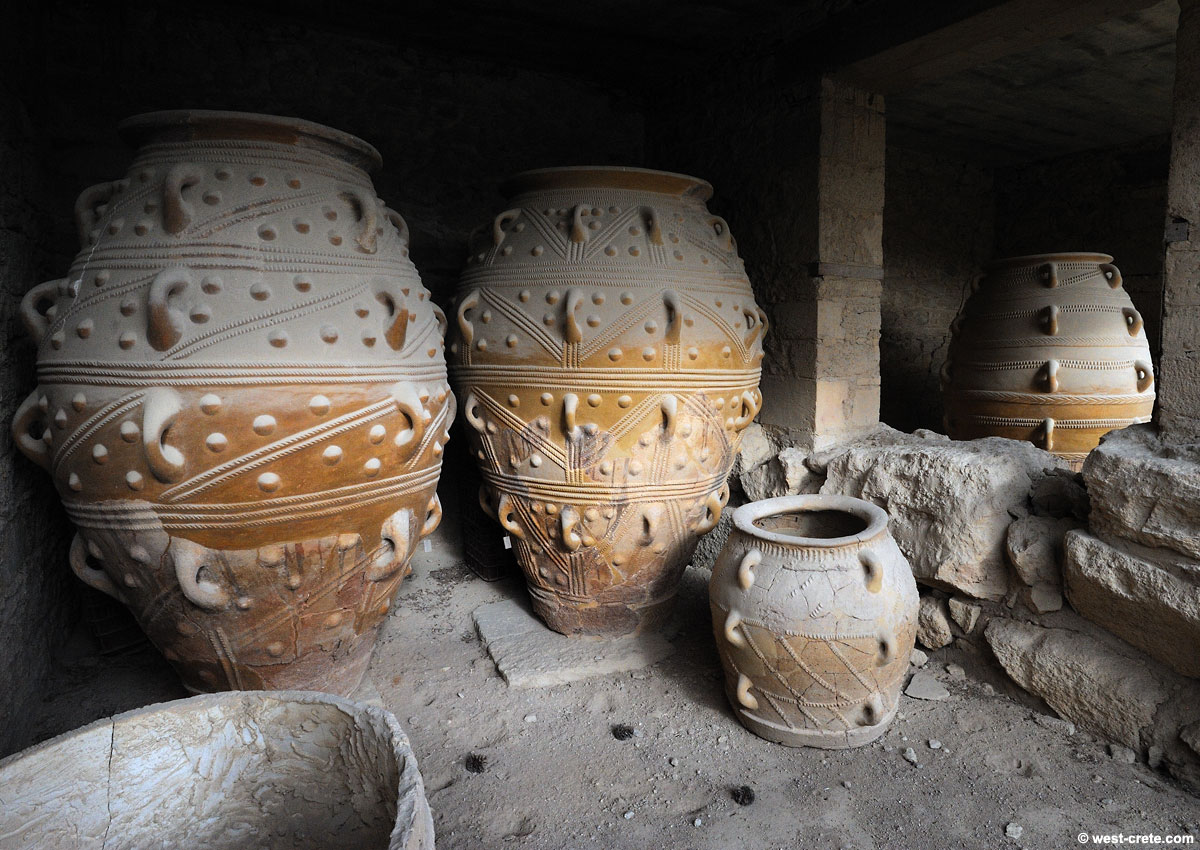
The antiseptic properties of honey have made it a preferred medium among many peoples for the preservation of delicate foods. And in Mexico honey has long been used to preserve psilocybin-containing mushrooms. The fact that Glaukos, the blue-gray one, fell into a honey pot...and was preserved there until the time of his resurrection seems highly suggestive. Herodotus mentions that the Babylonians preserved their dead in honey, and the use of large storage vessels, or pithoi, for burying the dead was widespread in the Bronze Age Aegean. The motif of cattle is present in the story in the bizarre section concerning the simile of the three-colored cow and the need to demonstrate linguistic facility as a precondition to being able to find the lost child. And the serpent, familiar from the Genesis story of Eden, makes a cameo appearance--and once again proves to have accurate and secret information concerning plants, especially plants that confer immortality. Polyidos, the shaman figure, uses the information gained from the serpent to return Glaukos to life; the information leaves Glaukos and returns to his departing teacher. This may refer to the elusive nature of the visions glimpsed during mushroom intoxication. […] all the motifs of a barely remembered mushroom cult are there--themes of death and rebirth, cattle, serpents with herbal knowledge, and a blue-gray child who is preserved in honey.
We also see here an explanation for Glaucos being the ‘son’ of the Minos-Asterion bull (or indeed of the Moon-Cow Pasiphae). As mycologists have pointed out, many psilocybin-bearing mushrooms are found naturally growing on the dung of cattle. The Minoans cannot have missed this important aspect of the plant’s culture – indeed this may have been how they or their Neolithic forebears discovered and cultivated this sacrament – and so encoded this detail into the myth as Glaucos son of the cow or bull. It is also noteworthy to consider that Glaucos has to enter the honey-pot, past the deathly owl and into the Underworld (the cellar), in order to transcend death. This resonates strongly with the honey given to the Mistress of the Labyrinth, suggesting the little son was only a sacrament once he had been transformed or preserved.
“Glaucos” by Bruce Rimell
My Thoughts
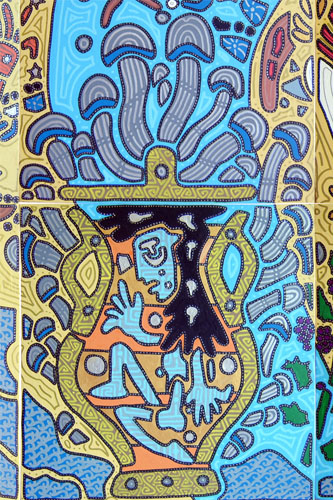
My own introduction to Glaukos was through the above quoted book by Terrence McKenna, which also quoted Apollodorus in full. I was quite stunned that this other brother of Ariadne had completely escaped my notice until then. (Pretty sneaky of him.) The second quoted source comes from an essay by Bruce Rimell which gets in-depth and speculative, but nonetheless fascinating reading. He even provides a theory as to how Glaukos son of Minos might be connected to Glaukos the sea-god (who otherwise are very different characters, excepting the same name and both having a magical herb being a part of their stories.) If you look at nothing else in the essay, at least check out the artwork and the extensive photo essays after the bibliography.
Now, I want to highlight some observations and questions about the myth of Glaukos.
Polyidos: Did you catch that he was the descendant of Melampos? I didn’t until recently, probably because Melampos was not strong on my radar until my involvement with the Thiasos of the Starry Bull, where he is recognized as one of the Dionysian heroes. Melampos was also a seer and prophet, and spread the worship of Dionysos. Both Graves and Hyginus note that Polyidos character was sometimes replaced with Asklepios.
Omens: The omen which leads Polyidos to the cellar is an owl frightening a swarm of bees. Although some versions gloss over this bit completely, Graves’ explains in his notes that the word for owl is “glaux”. In other words, this is a pun for Glaukos name, and the bees symbolic of his falling into honey in the cellar on which the owl is perching. (There could be double symbolism there in the owl being a bird of death/wisdom setting the bees [soul] to flight.) I love this glimpse into the way that omens were interpreted back then. I can’t recall if I’ve ever seen an omen that was a pun, which PROBABLY means I’m not paying enough attention.
Bees & honey: A lot has been written about the importance of honey and bees in ancient Crete, and it is represented often in their art. Honey was not just a food or commodity--it’s an immortal substance, a divine nectar, flowering nature itself, transformed into something entwined in both life and death. Honey had medicinal and magical properties, could be a preservative or embalming agent, and could be transformed into intoxicating mead. There are sources that indicate that the Greeks thought of bees as souls and they were thought to be born from the carcasses of bulls--their other most sacred animal. That Glaukos drowns in honey, and not in a pool of water or the ocean, would appear to point to some deeper symbolism here. Dionysos has several associations with honey as well.
The color-changing calf: Of all the details, this one seems most befuddling to the authors who provided possible interpretations to this myth. But as these three colors together seem to crop up in shamanic and mystery traditions, it didn’t seem so strange to me.
Animals and plants: This short myth has no less than 4 significant creatures in it. The calf, the owl, the bees and the snakes. And every single one is revealing some sort of knowledge. And then there is the enigmatic, unidentified plant. Was it unnecessary to identify it because it the plant itself was also one of its main characters? Are these two snakes the same held by the Minoan snake goddess/priestess figures? Also noteworthy is the fact that the magical herb did not have to be ingested, simply placed on the body. But as Ogden mentioned in his book, it was not just the plant, it was also the honey that had restorative powers.
Resurrection: In Greek mythology, Glaukos is one of the few people to be successfully returned from death to life. Usually this required an actual journey by a god or hero to the Underworld. And yet Polyidos is able to do this with just an herb revealed by a snake. Hmmm….
More mushroom connections: It’s a seemingly random detail, that Glaukos was eventually known for introducing a military girdle to Italy. Unless he already had the nickname “girdled” and the detail tacked on later by way of explanation? Maybe it’s a stretch, but it occurred to me that mushrooms have a skirt or girdle, called a ring or annulus, once the cap umbrellas out from the stem. Rimell came to this same possible conclusion.
If Glaukos were a mushroom, consider the cycle it creates... one where a swarm of bees is born from the carcass of a bull, which goes on to create the sacred honey, which can be used to preserve the mushrooms, which themselves grow from the dung of cattle. Another bit of Greek lore about mushrooms is that they were formed from lightning or thunderbolts hitting the ground, so that mushrooms are somehow connected to a Dionysian cult is perhaps not too far-fetched.
As much as I adore the idea of connecting my enthusiasm for mushrooms to my devotion to Dionysos, Ariadne and the whole bull mythos, I’m not entirely convinced Glaukos is a mushroom personified. Regardless, I have this special fondness for his myth (what survives of it) and its mysterious implications. Eventually I hope to share some UPG about Glaukos, but I didn’t want to go longer without introducing him, especially since my fascination of him goes back a couple years. My husband and I went down the rabbit hole of this myth together in the year before his death. So, I’ll leave you with a poem he wrote.
SONICRY
The only one who could ever teach me
was a blue honey-soaked son
He sighed like a maiden and held me like a mother
crooned a crone’s crow
a staggering echoing song
soaked me to the soul
He laid claims to the plains where every bull stamped its hoof
He lived under the trees of the forest floor
Glaukos son of Minos
brother of Dionysos
I hear your eyes when they are open
I feel your mouth when it’s closing
You’re closing in on me
My mouth fills with energy
I drown in your honey