Showing posts with label bull. Show all posts

Thursday, July 24, 2014

Where the Edge of the World Meets the Stars

Go forth, find and fix your gaze upon the Corona Borealis in the summer sky.  Think on what it means that Dionysos placed it there for Ariadne. Not as a story, but as truth. And then, speak aloud these words into the starry heavens: “I am going to die.”

I journeyed to my sacred forests and cliffs for the weekend to celebrate a festival for Ariadne as Lady of the Labyrinth.  Within and surrounding the festival, I also intended to experiment with some potential trance postures and dances whose depictions I’d been studying in the Minoan epiphany scenes.  Here I must again credit Bruce Rimell, whose essay and collection of images turned me onto this idea. Unfortunately, I still haven’t been able to track down the article he references about the visionary potential of these particular postures, but I’m familiar with the concept within the work of Felicitas Goodman, a different anthropologist (although Goodman never experimented with Minoan postures that I know of).  On the bright side, I didn’t have too many preconceived notions.

Although it wasn’t the first site I was shooting for, I ended up in the exact same place where my husband and I had privately exchanged vows nearly 3 years ago, and where last year in the worst throes of my grief I experienced one of the most profound omens of my life. The funny thing is that all three times I’ve gotten here it has been sort-of-by-accident, one way or another, which probably says something about the otherness of it.  If this place was a target, I’ve had to shoot sideways to hit it!  And I was grateful I did, especially by the end of this trip,  when I could feel all my accumulated experiences there like so many personal ley-lines, creating a particular affinity with the place and spirits.  It’s hard to put into words, and I don’t think I’ve ever felt a place-relationship so profoundly.  Just thinking about it makes me want to get up and drive back and leave more offerings.  When I was resting there it came to mind what I knew, had already known, but was interesting to think about while I was THERE — that if I have my way, this is where my ashes will end up when I die.  It was a peaceful thought.

cropped landscape
thesecliffs
cliffs

The first night I just focused on setting up camp (in the dark, as usual–the pictures were taken later in the trip) and making myself a rustic dinner on the campfire. Some food and wine offered up to the fire with thanks to the gods and spirits.  Some past visitor had even hung prayer flags high above the fire pit.

prayerflags

The following morning had me feeling a little lonely, emotional and restless.   I’ll elaborate briefly since it’s relevant for what occurred in the ritual later. I felt a temptation to distract myself with something innocuous, and underlying that, I sensed a bubbling up of something terrifying. I had to sit with it and journal to get to something even close to describing it… a fear of meaninglessness, and a subsequent despair.  This fear is multifaceted–affecting the past and future (could all I’ve been through be for nothing? does what comes next in life matter?), and especially to the present, where I no longer have my soul-mate here to give me purpose and reality. That last bit might sound strange, but the loss of the comforting validation offered by such deep companionship sometimes makes me feel like I’m dissolving, or that my actions don’t echo, whether they are menial or ambitious.  Fears are not logical. I didn’t sit with this for too long — I named the fear and then left it for later, because anything else at the moment would have turned into some serious wallowing.

I did some hiking, and found a ton of wild black raspberry bushes.  They seem to adore fallen trees, sloped ground, and plenty of sun.  Once, my husband and I had discovered some maybe a couple miles away from this spot, with the whimsical delight of explorers discovering something entirely novel and new, and we named them “rimberries” and made a pie out of them when we got home.  Every other subsequent time we’d gone camping in the area we had been either too early or too late for them, so this was a neat find, even considering that over 80% of them were not ripe.  So it was, with my husband and ancestors especially in mind, that I spent a good couple hours getting up close and personal with the very thorny, berry-laden whips.  Luckily, I had gloves, though the thorns would still sometimes bite through the leather and constantly snagged my clothes.  I’m nothing if not stubborn.  (I did make a pie with these berries after going back home, and even made my first homemade pie crust to do them justice. I never considered that making something from scratch actually meant the scratches you get from wild-harvesting the ingredients! Hardest I’ve ever worked for a pie, ever.)


rimberries

Along with the rimberry bushes, there were mullein plants everywhere, and even a sprig or two of blossoming yarrow poking out unobtrusively here and there. There were multiple varieties of pine, of course, and some oak as well. There was a small prickly weed with purple blossoms that caught my attention, maybe because it had a fuzzy bumblebee on it.  I had no idea what it was, but felt compelled to take a picture to see if I could find out later.  

I tried a couple of the postures during the day — the first one in the afternoon and second one at sunset. The first one, described as a “Tense Salute”, involved standing straight with the chest pushed out to create a forward arch to the back, the right hand in a fist or circle with the thumb/index finger side of the fist held up to the forehead, and right elbow pointed out to the right.  The left arm is held down stiffly straight down with the hand next to the thigh, held so the palm curls upward as if holding a ball. The feet stand just a few inches apart, and the head is straight forward.  (Usual method employed with trance postures — grounding and meditation, then invitation & offerings to the spirits, followed by the posture itself for 15 minutes while listening to a recording of drumming or rattling.)  There were some vague impressions to this one, but all in all I feel like I’m missing some context for it, yet I feel pretty certain it’s not a divinatory posture.  More experimentation needed.  More strenuous than expected.  


tense salute

The second one was the baetyl posture.  To be honest, I wasn’t even sure if this one could be considered a trance posture, because there is some movement implied and the inclusion of the stone makes it quite unlike any others I have seen.  But what made me try it anyway was the similarities across different epiphany images.  One leg is slightly forward from the other, the person is always kneeling with one elbow or forearm anchored to the top of the stone, and usually the toes are down on the ground while the heels are pointed up.  Most images show the the person turned to something behind them with the other arm not grounded on the baetyl held out in a “beholding” or beckoning manner, with the palm flat and the forearm at a 45 degree angle (a significant angle in trance postures, for some reason.)  There was also an image with the person still facing and holding onto the baetyl with both hands, which is where the implied movement comes in.  Presumably one begins with both arms on the baetyl and the head  bowed towards it, then moving to look behind and stretching out one arm.  That’s how I tried it.  
baetyl epiphany

I moved back and forth a couple times, switching sides as well.  There were less visuals than sensation (but then again I’m not particularly visual), and I will say that I think the first position of bowing at the baetyl should be the bulk of the posture until one feels moved to stretch behind.  I’ll say that this one was pretty compelling, but I’m not going to go too much into it now, because I want to experiment further. I should add that I blessed the baetyl stone first, with water and floral water, which only seemed right.  Obviously these stones had a religious significance we can only guess at and can’t completely duplicate (especially by picking a stone at random.)  But from what I’ve read and experienced with ecstatic postures, they are like keys or bridges to the spirit world, whether that key is inherent in the body-position itself or the tapping into the cumulative experience of the ancestors who might have used them. So while the full context of the postures and their significance to the ancient cultures who used them may not be recoverable, there’s still plenty of wisdom to be gained from them.


*                              *                              *

negativetrees sunset

As the stars began to come out, I began an ecstatic ritual for Ariadne.

I changed into a skirt, anointed myself with a perfume I only use for Dionysian rituals… I had drawn a 7-circuit labyrinth on a flat stone to use as an altar. I burned honey-rose kyphi… I called upon Ariadne and Dionysos… Used my rattle and my bull horn…  poured out the mead and offered up honey.

The starry crown was directly overhead.  It was my anchor.

I might have wished for a whole crowd of worshippers with me, with some to play music for the dance.  But at least this lone worshipper had headphones.


dancing epiphany

I don’t ever want to forget that feeling as I began to dance on the edge of the world, bare-breasted under the stars, with the endless sky all around me.  I raised my arms to mimic the Minoan dances, arms staggered up with palms out, as if I was mediating the heavens and earth.  What is stationary and puzzling in art translated itself into movement with surprising effortlessness.  And in that moment, the questions which plagued me before, the questions of meaninglessness, were not provided any grand answers — instead, the questions were simply dissolved.  

I thought, “Absurdity is just truth looking for context.”

The wind and the bats flew around me.  The darker the earth got the brighter the sky became, so the pine trees turned into negative space, while the whole sky exploded into a glittering kaleidoscope.

More mead.  More dance.  Where swinging my head around meant turning the stars on their axis.  Where I somehow never tripped in spite of the darkness, in spite of the rocks and uneven ground.  (“The gods will always catch me, the gods are greater than gravity.”)  I remember screaming once, a strangled sound I doubt I’ve ever made before. Then howling.

Things get a bit fuzzy.  I barely remember tree-pulling, that was fun.  I broke from the dance a couple times then returned to it.  I started a fire to have a feast.  At some point I laid down on the ground so I could better see the milky way and stars in their entirety.  Occasionally I came back to the altar and traced the labyrinth with my finger. I honestly don’t even remember deciding to go to bed whenever I finally did.

I do remember that the challenge I put at the beginning was one I felt I was supposed to share, as I experienced it:

Go forth, find and fix your gaze upon the Corona Borealis in the summer sky.  Think on what it means that Dionysos placed it there for Ariadne. Not as a story, but as truth. And then, speak aloud these words into the starry heavens: “I am going to die.”

And then dance…

P.S. Remember that mysterious little thorny plant I mentioned?  It was a bull-thistle.  With a bee.


bullthorn & bee

Tuesday, June 24, 2014

Her Other, Blue-Grey Brother


The Myth


Apollodorus 3.3.1
... But Glaucus, while he was yet a child, in chasing a mouse fell into a jar of honey and was drowned. On his disappearance Minos made a great search and consulted diviners as to how he should find him. The Curetes told him that in his herds he had a cow of three different colors, and that the man who could best describe that cow's color would also restore his son to him alive. So when the diviners were assembled, Polyidus, son of Coeranus, compared the color of the cow to the fruit of the bramble, and being compelled to seek for the child he found him by means of a sort of divination. But Minos declaring that he must recover him alive, he was shut up with the dead body. And while he was in great perplexity, he saw a serpent going towards the corpse. He threw a stone and killed it, fearing to be killed himself if any harm befell the body. But another serpent came, and, seeing the former one dead, departed, and then returned bringing a herb, and placed it on the whole body of the other; and no sooner was the herb so placed upon it than the dead serpent came to life. Surprised at this sight, Polyidus applied the same herb to the body of Glaucus and raised him from the dead.
Minos had now got back his son, but even so he did not suffer Polyidus to depart to Argos until he had taught Glaucus the art of divination. Polyidus taught him on compulsion, and when he was sailing away he bade Glaucus spit into his mouth. Glaucus did so and forgot the art of divination.

Hyginus’ Fabulae [136] CXXXVI. POLYIDUS
When Glaucus, son of Minos and Pasiphae, was playing ball, he fell into a jar full of honey. In the parents’ search, they made inquiry of Apollo about he boy. Apollo told them: A prodigy has been born for you. Whoever explains it will restore the child to you. Upon hearing this reply, Minos began inquiring from his people about the prodigy. They told him that a bullock had been born which changed colour three times a day, every four hours - first white, then red, then black. Minos then called together the augurs to explain the prodigy, and when no one was found who could do so, Polyidus, son of Coeranus, showed that the bullock was like a mulberry tree, for first its fruit is white, then red, and when ripe, black. Then Minos said to him: “According to the words of Apollo, you should be able to restore my son to me.” While Polyidus was observing omens, he saw an owl sitting over the wine-cellar and putting bees to flight. He interpreted the omen, and brought out the lifeless boy from the jar. Minos said to him: “You have found the body. Now restore life to it.” When Polyidus said this was impossible, Minos ordered him to be shut in a tomb with the boy, and a sword placed there. When they had been shut in, a snake suddenly made for the body of the boy, and Polyidus, judging the creature whished to devour the body, suddenly drew the sword and killed it. Another snake, seeking its mate, saw that it was dead, and came and brought a herb, and its touch restored life to the dead snake. Polyidus did the same. When they called out from within, a passerby reported it to Minos, who opened the tomb and found his son safe. He sent Polyidus many gifts back into his country.

Robert Graves’ The Greek Myths
90c. Glaucus, while still a child, was playing ball one day in the palace at Cnossus or, perhaps, chasing a mouse, when he suddenly disappeared. Minos and Pasiphae searched high and low but, being unable to find him, had recourse to the Delphic Oracle. They were informed that whoever could give the best simile for a recent portentous birth in Crete would find what was lost. Minos made enquiries and learned that a heifer-calf had been born among his herds which changed in color thrice a day - from white to red, and from red to black. He summoned his soothsayers to the palace, but none could think of a simile until Polyeidus the Argive, a descendant of Melampus, said: ‘This calf resembles nothing so much as a ripening blackberry [or mulberry].’ Minos at once commanded him to go in search of Glaucus.
d. Polyeidus wandered through the labyrinthine palace, until he came upon an owl sitting at the entrance to a cellar, frightening away a swarm of bees, and took this for an omen. Below in the cellar he found a great jar used for the storing of honey, and Glaucus drowned in it, head downwards. Minos, when this discovery was reported to him, consulted with with the Curetes, and followed their advice by telling Polyeidus: ‘Now that you have found my son’s body, you must restore him to life!’ Polyeidus protested that, not being Asclepius, he was incapable of raising the dead. ‘Ah, I know better,’ replied Minos. ‘You will be locked in a tomb with Glaucus’s body and a sword, and there you will remain until my orders have been obeyed!’
e. When Polyeidus grew accustomed to the darkness of the tomb he saw a serpent, approaching the boy’s corpse and, seizing his sword, killed it. Presently another serpent, gliding up, and finding that its mate was dead, retired, but came back shortly with a magic herb in its mouth, which it laid on the dead body. Slowly the serpent came to life again.
f. Polyeidus was astounded, but had the presence of mind to apply the same herb to the body of Glaucus, and with the same happy result. He and Glaucus then shouted loudly for help, until a passer-by heard them and ran to summon Minos, who was overjoyed when he opened the tomb and found his son alive. He loaded Polyeidus with gifts, but would not let him return to Argos until he had taught Glaucus the art of divination. Polyeidus unwillingly obeyed, and when he was about to sail home, told Glaucus: ‘Boy, spit into my open mouth!’ Glaucus did so, and immediately forgot all that he had learned.
g. Later, Glaucus led an expedition westward, and demanded a kingdom from the Italians; but they despised him for failing to be so great a man as his father; however, he introduced the Cretan military girdle and shield into Italy, and thus earned the name Labicus, which means ‘girdled’.

Daniel Ogden’s Greek and Roman Necromancy
The Greeks used honey as a general preservative, and in particular made use of it when they wished to embalm their dead...  Other Greek traditions preserve a link between honey, resurrection, and necromancy. Thus the Cretan king Minos's son Glaucus disappeared and died by falling into a pot of honey. Polyidus ("the much seeing"), commissioned by the king to find him was led to the jar by a dream. Minos then ordered Polyidus to restore the boy to life, and, when he could not, had him immured with him in his tomb. A snake then brought and demonstrated a magic herb, which Polyidus used to resurrect Glaucus. The honey was evidently integral to the resurrection, for the summary proverb said, "Glaucus drank honey and rose again."

The Mushroom

Terrence McKenna’s Food of the Gods
Let us attempt to analyze this peculiar story. First of all, it is necessary to comment on the significance of the names of the two main characters: Polyidos is clearly “the man-who-has-many-ideas,” and Glaukos simply means “blue-gray”. The meaning of Glaukos was for me the entry point into the intention of the myth. It is well known among mycologists that the flesh of Stopharia cubensis and other psilocybin mushrooms has the property of staining a bluish color when bruised or broken. This blue staining is an enzymatic reaction and a fairly reliable indicator of psilocybin. Glaukos, the youth who is preserved in the jar of honey, seems symbolic of the mushroom itself…
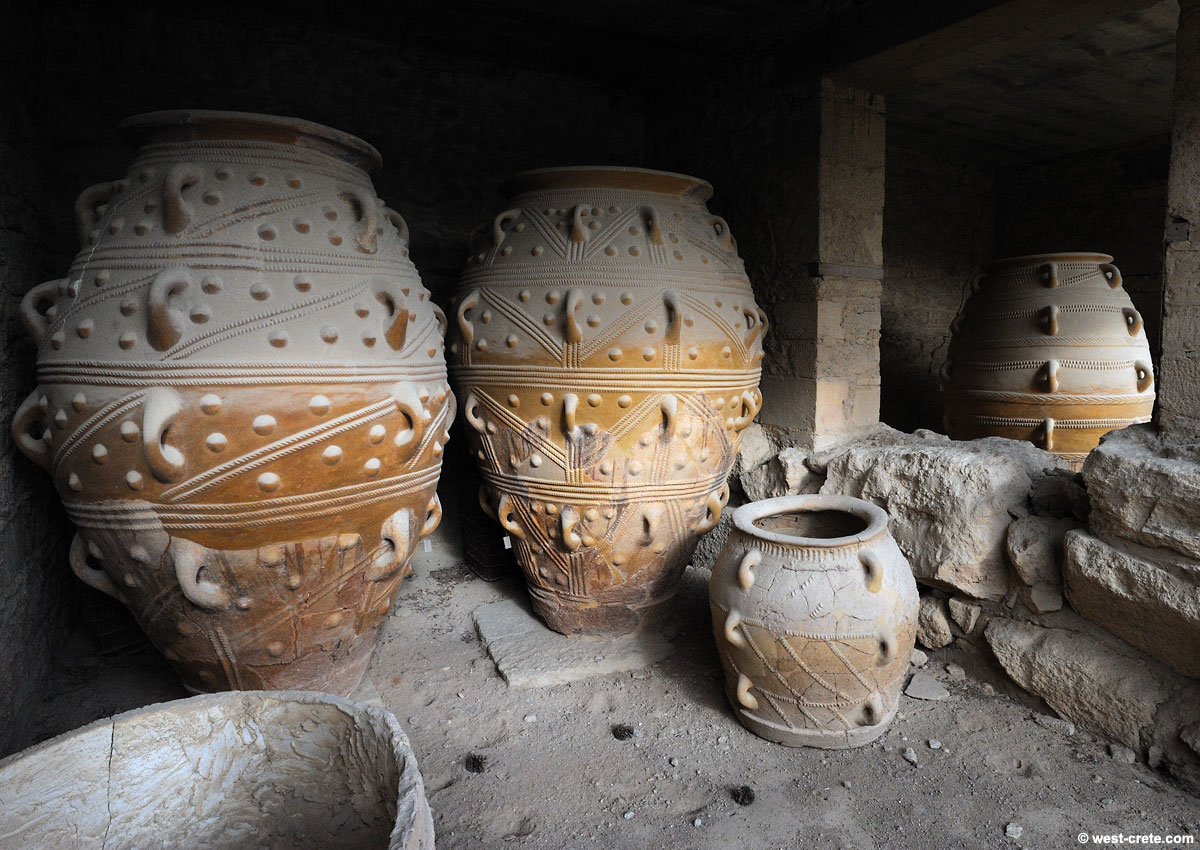
    The antiseptic properties of honey have made it a preferred medium among many peoples for the preservation of delicate foods. And in Mexico honey has long been used to preserve psilocybin-containing mushrooms. The fact that Glaukos, the blue-gray one, fell into a honey pot...and was preserved there until the time of his resurrection seems highly suggestive. Herodotus mentions that the Babylonians preserved their dead in honey, and the use of large storage vessels, or pithoi, for burying the dead was widespread in the Bronze Age Aegean. The motif of cattle is present in the story in the bizarre section concerning the simile of the three-colored cow and the need to demonstrate linguistic facility as a precondition to being able to find the lost child. And the serpent, familiar from the Genesis story of Eden, makes a cameo appearance--and once again proves to have accurate and secret information concerning plants, especially plants that confer immortality. Polyidos, the shaman figure, uses the information gained from the serpent to return Glaukos to life; the information leaves Glaukos and returns to his departing teacher. This may refer to the elusive nature of the visions glimpsed during mushroom intoxication. […] all the motifs of a barely remembered mushroom cult are there--themes of death and rebirth, cattle, serpents with herbal knowledge, and a blue-gray child who is preserved in honey.

Bruce Rimell’s “Minoan Honey : The Bull, The Mushroom And The Mistress Of The Dance” (Essay & Accompanying Art)  

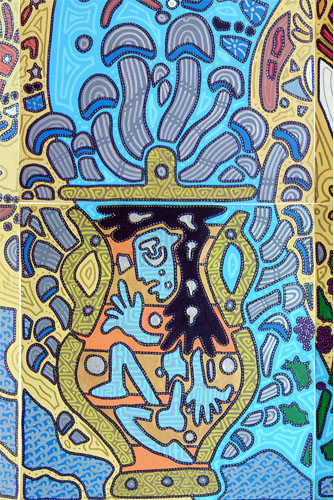
We also see here an explanation for Glaucos being the ‘son’ of the Minos-Asterion bull (or indeed of the Moon-Cow Pasiphae). As mycologists have pointed out, many psilocybin-bearing mushrooms are found naturally growing on the dung of cattle. The Minoans cannot have missed this important aspect of the plant’s culture – indeed this may have been how they or their Neolithic forebears discovered and cultivated this sacrament – and so encoded this detail into the myth as Glaucos son of the cow or bull. It is also noteworthy to consider that Glaucos has to enter the honey-pot, past the deathly owl and into the Underworld (the cellar), in order to transcend death. This resonates strongly with the honey given to the Mistress of the Labyrinth, suggesting the little son was only a sacrament once he had been transformed or preserved.

glaucos in the honey pot
“Glaucos” by Bruce Rimell

My Thoughts

My own introduction to Glaukos was through the above quoted book by Terrence McKenna, which also quoted Apollodorus in full.  I was quite stunned that this other brother of Ariadne had completely escaped my notice until then.  (Pretty sneaky of him.)  The second quoted source comes from an essay by Bruce Rimell which gets in-depth and speculative, but nonetheless fascinating reading.  He even provides a theory as to how Glaukos son of Minos might be connected to Glaukos the sea-god (who otherwise are very different characters, excepting the same name and both having a magical herb being a part of their stories.) If you look at nothing else in the essay, at least check out the artwork and the extensive photo essays after the bibliography.

Now, I want to highlight some observations and questions about the myth of Glaukos.

Polyidos: Did you catch that he was the descendant of Melampos?  I didn’t until recently, probably because Melampos was not strong on my radar until my involvement with the Thiasos of the Starry Bull, where he is recognized as one of the Dionysian heroes.  Melampos was also a seer and prophet, and spread the worship of Dionysos.  Both Graves and Hyginus note that Polyidos character was sometimes replaced with Asklepios.

Omens: The omen which leads Polyidos to the cellar is an owl frightening a swarm of bees. Although some versions gloss over this bit completely, Graves’ explains in his notes that the word for owl is “glaux”.  In other words, this is a pun for Glaukos name, and the bees symbolic of his falling into honey in the cellar on which the owl is perching.  (There could be double symbolism there in the owl being a bird of death/wisdom setting the bees [soul] to flight.)  I love this glimpse into the way that omens were interpreted back then.  I can’t recall if I’ve ever seen an omen that was a pun, which PROBABLY means I’m not paying enough attention.

Bees & honey:  A lot has been written about the importance of honey and bees in ancient Crete, and it is represented often in their art.  Honey was not just a food or commodity--it’s an immortal substance, a divine nectar, flowering nature itself, transformed into something entwined in both life and death.  Honey had medicinal and magical properties, could be a preservative or embalming agent, and could be transformed into intoxicating mead. There are sources that indicate that the Greeks thought of bees as souls and they were thought to be born from the carcasses of bulls--their other most sacred animal.  That Glaukos drowns in honey, and not in a pool of water or the ocean, would appear to point to some deeper symbolism here.  Dionysos has several associations with honey as well.

The color-changing calf:  Of all the details, this one seems most befuddling to the authors who provided possible interpretations to this myth.  But as these three colors together seem to crop up in shamanic and mystery traditions, it didn’t seem so strange to me.

Animals and plants:  This short myth has no less than 4 significant creatures in it. The calf, the owl, the bees and the snakes. And every single one is revealing some sort of knowledge.  And then there is the enigmatic, unidentified plant.  Was it unnecessary to identify it because it the plant itself was also one of its main characters?  Are these two snakes the same held by the Minoan snake goddess/priestess figures? Also noteworthy is the fact that the magical herb did not have to be ingested, simply placed on the body. But as Ogden mentioned in his book, it was not just the plant, it was also the honey that had restorative powers.

Resurrection:  In Greek mythology, Glaukos is one of the few people to be successfully returned from death to life.  Usually this required an actual journey by a god or hero to the Underworld.  And yet Polyidos is able to do this with just an herb revealed by a snake.  Hmmm….

More mushroom connections:  It’s a seemingly random detail, that Glaukos was eventually known for introducing a military girdle to Italy.  Unless he already had the nickname “girdled” and the detail tacked on later by way of explanation?  Maybe it’s a stretch, but it occurred to me that mushrooms have a skirt or girdle, called a ring or annulus, once the cap umbrellas out from the stem.  Rimell came to this same possible conclusion.  
    If Glaukos were a mushroom, consider the cycle it creates... one where a swarm of bees is born from the carcass of a bull, which goes on to create the sacred honey, which can be used to preserve the mushrooms, which themselves grow from the dung of cattle.  Another bit of Greek lore about mushrooms is that they were formed from lightning or thunderbolts hitting the ground, so that mushrooms are somehow connected to a Dionysian cult is perhaps not too far-fetched.


As much as I adore the idea of connecting my enthusiasm for mushrooms to my devotion to Dionysos, Ariadne and the whole bull mythos, I’m not entirely convinced Glaukos is a mushroom personified.  Regardless, I have this special fondness for his myth (what survives of it) and its mysterious implications.  Eventually I hope to share some UPG about Glaukos, but I didn’t want to go longer without introducing him, especially since my fascination of him goes back a couple years.  My husband and I went down the rabbit hole of this myth together in the year before his death.  So, I’ll leave you with a poem he wrote.


SONICRY

The only one who could ever teach me
was a blue honey-soaked son
He sighed like a maiden and held me like a mother
crooned a crone’s crow
a staggering echoing song
soaked me to the soul
He laid claims to the plains where every bull stamped its hoof
He lived under the trees of the forest floor
Glaukos son of Minos
brother of Dionysos
I hear your eyes when they are open
I feel your mouth when it’s closing
You’re closing in on me
My mouth fills with energy
I drown in your honey


Sunday, February 3, 2013

Lenaia


Last week was the Lenaia, and it took up nearly all of my days off, right up until another long work week.  Therefore I'm a little late writing about it!

Our Lenaia was rainy, almost the whole four days of it, unbelievably!  So that remains an important part of my memory of it.  The unexpected wetness of the desert.  The way that everything was more vivid, from the clean air to the way everything shines when wet.  On the last day of the Lenaia, it struck me how water itself is an important element of the festival.  It is the rain or snow that will allow the flowers to bloom on Anthesteria.  It is the nourishing element of the god, it is the water that we mix with the wine.  I don't usually temper my wine with water, but I always will on the Lenaia, because it seems right.
 
On the first day, my husband and I had a feast of local foods, and mostly just enjoyed food, wine and each other's company.  On the second, we went to see the play Equus put on by a small but talented theatre company.  I had seen other plays by this company before, so I knew that they were good and their performances were intimate and challenging.  But I hadn't seen Equus and was unfamiliar with anything except the most basic premise.  It turned out to be incredibly appropriate in its themes for a Dionysian festival (including questioning of what is normal, what is crazy, and the need for ecstatic states of consciousness.)  The horses were played by people in provocative bondage outfits with shaped-wire horse masks.  The narrator is a self-described pagan at heart and even mentioned Dionysos' name in the play.  It was intense and I absolutely loved it.  Did I mention we got to drink wine while watching the play too?  It was lovely.
 
I should mention that on the way to the play and home again, the ipod was on shuffle and was particularly synchronous.  Like, wow. 
 
We went home and I made all my preparations for my planned solitary ritual.  This ritual was significant for me for a few reasons, besides being my first serious observance of the Lenaia.  (Though I've done something simple the last two years, I'm only now getting a grasp on it.)  Since devoting myself to Dionysos, I had ended up rejecting a lot of the set ritual that I was used to, meaning the Wicca-influenced structure of circle casting, quarter calling, invoking, etc.  Not because I think it's wrong, but it ceased to speak to me, and it was more challenging, more Dionysian, to do things without structure, as spontaneously as possible.  However, I think ritual is important, and that ritual structure and symbolism speaks to our deeper self, and is often needed for important works and for communing with the gods. So I was trying to find a balance with these ideas, something that's structured but not too much, a ritual that is both Dionysian and speaks to me.  (Naturally, it's a work in progress and probably always will be.)  


Also, if you're not familiar with the Lenaia festival, read this excellent article by Sannion.  My comments illustrate some of my thoughts as I've researched the festival.  I also took inspiration from a dream I had on the Lenaia last year.

This is what I did...


I set up my wooden mask of Dionysos on a tall altar that was draped in cloth and decorated with ivy.  On the altar was also the libation cup, a bowl for wine and a bowl for water.  On the lower platform beneath it was a clay phallos in a basket, covered with a veil.  


I took a bath in candlelight, then entered my ritual space.  I blessed some spring water with breath and salt, and use a sprig of rosemary to asperge the space.  I lit all the candles around the room.  I let the incense fill the room.  I anointed myself with a perfume oil that reminds me of the god.


"With sacred waters, I cleanse this space for the god who comes."
"With sacred flame, I light this space for the god who comes."
"With sacred smoke, I prepare this space for the god who comes."
"With sacred oil, I anoint myself for the god who comes."

I take up my thyrsus, feel it's power, remember the times I've danced with it.  I call to mind a dream of mine, of a sacred garden with high walls covered in ivy.  I let this image meld with the room I'm in.  I call the ivy up as a protective barrier.

I ask the spirit of the Bull to be present, to guard the exterior.  I call the spirit of the Panther, intending to ask the same but instead I find myself inviting Panther in with me, to protect the interior.  Panther has been a companion in my dreams even before I began worshipping Dionysos.  It feels right.


I vibrate my chakras twice.  Once with my usual method with the Greek god names, and again with epithets of Dionysos.  Energy becomes more palpable now, and I direct all my movement, my energy and attention to the Mask.

I praise Zeus and Semele.  I praise the nymphs, and read them a hymn.

I speak to the Mask.  Some words of my own, then some borrowed...

 "Dionysos! The Mask embodies Your power more than that of any other God! No mortal dons Your mask, for Your power resides in the empty mask. Your eyes transfix us, steadier than any human gaze. We reply to Your face in the inmost depths of our souls. You confront us in Your paradox. Child of a God and a mortal, born of Heaven and Earth, uniter of opposites. Lord of Moist Nature, Born of Fire. You are the Primordial Force of Life, madly creating and destroying as You will! For Indestructible Life implies both birth and death. Your mask dramatically unifies illusion and reality. No body, nothing behind the surface: pure persona. Ephemeral shell. Absent, yet present. Appearing and disappearing. At once you are and are not...
 
"One part of you eternal, while the other part slumbers. Dionysos Masked and Dionysos Liknites. Behold the mask.  Behold the Liknon."


I take the Liknon.  I cradle it in silence, rocking it occasionally.  After a few moments, I whisper, "Now wake, my God! Hear my voice... know my devotion..."

I take up my gourd rattle, find a rhythm and chant over the Liknon... "Awaken, Son of Semele! Iakkhos, Iakkhos!"  Over and over.  My voice sometimes audible and sometimes inaudible.  There is no sense of energy being raised, as I intended.  Just the syllables and the rattle, again and again.  I persist.  And then the moment comes, unexpectedly in a sudden wave.  I unveil the Liknon.


"As promised, the god awakens! Hail Dionysos!  Hail Iakkhos!"

The wine is poured into the offering bowl... "The blood of the dismembered god, the sacrifice of the vine!"

The water is poured into the offering bowl... "The sweat and tears of the Lenai, the nymphs and the nursemaids."

I ladle out a cup, holding in up in a wordless moment, then drink.  And drink more.


At this point, I had intended to dance devotionally to a playlist of music.  But I hadn't had any time to create one.  Up until now, I didn't know if I was going to let it go random, or pick song by song.  I think back to earlier in the evening, when the music had been so synchronous, and I'm encouraged.  But anything could come up on that ipod... there's some weird stuff in those 3000+ tracks that would be off-putting, would definitely not be right, would not even be something I could dance to.  And IF I set it to random I would be committing myself to those songs, to the belief that they would be intended.  I couldn't change it after that, I would have to have faith and just go with it.  And with that thought, I know that's what I have to do.  


I asked Dionysos to choose, and I hit shuffle. 

Which is how I ended up dancing to "While My Guitar Gently Weeps."  And then "Decatur" by Sufjan Stevens.  And as the rest of the songs came up, I started realizing the way they all fit together, in mood and rhythm and flow.  These were not any gothic or rock songs.  These songs had a lighter touch, they were somewhat melancholy but with a touch of hope or whimsy, yet easy to dance to.  As I danced, I felt like the god was communicating not only an approval in my faith, in my willingness to relinquish control, but also communicating to me the mood of the festival itself.  And this was absolutely amazing to me.  I reciprocated this gift by dancing all my joy and love for Him.

These were the rest of the songs:

What's Wrong - Grizzly Bear
Kindness of Strangers - The American Analog Set
All My Days - Alexi Murdoch
Moonchild - M83
Deep Blue - Arcade Fire
I'm Not - Panda Bear
We Could Have Flown Like Pollen - ThouShaltNot

(One thing I jotted down post-ritual was "The god makes a better mix tape than I could."  Haha.)

The last two days were more mellow.  Friday was the day our pagan book discussion group meets.  The fact that we were celebrating Lenaia that weekend and that we would be absent next month due to the Anthesteria led me to trying to explain these festivals and what we do.  They seemed both surprised that I don't celebrate the sabbats anymore (with the exception of winter solstice, really) and interested in what we do and how enthusiastic we are.  I'm slowly becoming more open to family and acquaintances about the festivals we celebrate and that I worship Dionysos.  It's surprising how hard it can be to explain when I feel like I'm still figuring it out myself, but I've realized that that's okay.


On the last day of Lenaia, we had planned to go dancing at our favorite goth club, the place that has hosted some of my most significant moments of trance-dancing with Dionysos.  I was very sad to discover earlier in the day that the club has closed, presumably for good.  We looked for other options, but found no suitable ones. My husband passed out early, so I took a bottle of pinot noir for a night-time walk.  


The night was cloudy yet the full moon still peaked through now and then. I didn't even need a jacket, with the humidity.  I walked along the river wash, which is usually dry but was now wet, and visited the places that I knew we would return to on Anthesteria, imagining how they would be transforming in just a matter of weeks.  I looked into dark puddles of water and poured wine into them.  A coyote soundlessly crossed my path and I mentally acknowledged him and continued on.  No toads out, despite the rain... might be too early for them yet.  The raindrops glittered on the creosote branches.


Mostly I just listed to music and let everything sink in.  I thought about the water, as I mentioned before.  And I thought of how Lenaia is about awakening, and Anthesteria is about emerging.

I was tipsy when I got home, and I threw on a movie -- V for Vendetta.  It occurred to me partway in that I had picked a movie about a man in a mask without even thinking about it.  Figures!


It was a great festival this year, and I look forward to seeing how it evolves for me.  I feel Anthesteria approaching, too.  It's like a buzzing of energy, a sense of anticipation.   What has been awakened is stirring.