Monday, July 7, 2014

A Storm for Prophets

The Feast of the Dionysian Prophets last Thursday coincided with a surprise blessing - the first monsoon of the season!

I live in the southwest in Arizona, where monsoon season begins sometime after the summer solstice. This is when we get the bulk of our rainfall, although even that has been very little the last few years, as we are in the midst of a drought like other parts of the country.  These storms can come with almost no warning.  And sometimes they have a unpredictable frenzy to them -  coming in bursts that can tear off doors or roofs, knock down light or traffic poles, kick up dust and throw down lightning.  Yeah, unpredictable!

I love it!

I was working graveyard shift that night, and we were only a couple hours in when it started to hit.  My coworkers know SOME measure of my eccentricities, so they were forgiving (if still a bit surprised) when I dropped everything I was doing and ran out into the rain.  I was surrounded by the smell of heat and wet and chaparral and dust as I raised my face to the pelting rain and breathed it all in.  The pure energy of it is indescribable.

My lunch break was fairly early and by that time the rain had stopped but the lightning had not.  I walked further out to get a full view of the sky.  I thought, fuck the fireworks - this is so much better.  And it was!  The lightning was coming from every direction - close, far, sideways and longways.  I don’t think I’ve ever been in the midst of a lightning storm so beautiful and prolific. I was so moved and exhilarated that my prayers were clumsy repetitions.  I poured out the only libation I had, kombucha tea I had made at home.  To Dionysos, to the nymphs, to the heroes.

The energy stayed with me, so after the sun came up and I started for home, I bought a bottle of honey whiskey for offerings and did a short round of The Oracle of the Doors (as created by Sannion) whilst listening to The Doors on shuffle.  (Lyrics that jumped out at me included “whiskey” and “king snake”.)  These were my questions and answers, which seem quite powerful, and I am still pondering.  Comments/interpretations welcome.

What does Dionysos wish me to know?
466 Life goes on absorbing war
341 A wrong gesture. Too long and curious a glance.
442 Your ballroom days are over.

What do my ancestors wish me to know?
543 But can you still recall the time we cried
643 Break on through to the other side
365 Hordes crawl and seep inside

Where do I go next?
555 “Alive!” she cried
343 Blood is the rose of mysterious union
252 river flow, on and on it goes


[To learn more about the Dionysian Prophets honored by The Thiasos of the Starry Bull, of which Jim Morrison is only one, visit The Boukoleon. The thiasos chat on 7/3 on this topic was really good!] 

Arachneia the First: Plants, Dreams, Stars

[The Arachneia is a festival in the Bacchic Orphic tradition I am involved with called The Thiasos of the Starry Bull.  The festival celebrates the weaver Arachne, who is considered a Dionysian heroine, and her transformation into a spider.  You might notice this cross-posted at The Boukoloen, which you should definitely check out for more about the tradition, our deities, and writings from others!]


On Friday night before the Arachneia (being our devotional day for the Dionysian Heroines), I braided/wove some purple yarn into a long bracelet while saying an impromptu prayer to Arachne under the stars. I had initially planned to hang this in a tree once I finished, but instead I was compelled to wear it as a bracelet as a reminder of her throughout the weekend.

Saturday was a bit of a wash.  I got very little sleep that morning in order to transition from my usual graveyard schedule.  I needed to be able to manage a 3 hour drive very early on Sunday morning to attend an herbal festival up north.  I don't know if that's why I ended up dreaming so vividly.  Is it better to dream at night, to receive messages from spirits and gods?  I had honestly never thought of this until now, but I've been doing the better part of my sleeping and dreaming during the day for the last ten years.  For the first time, I'm seriously considering the ramifications of this.  On the flip side, always being awake at night may be a boon for ritual/divinatory work and cultivating altered states of consciousness.  Regardless, on Saturday night, I had a very significant, vivid and lucid dream, which I shall type up just as I journaled it that day:


Dream of [my husband]. Heard him talking and his voice was so resonant and beautiful and familiar that it snapped me into being lucid in the dream. And when I knew, he knew that I knew. I reached for him, touched him, took him all in. I wanted to absorb every bit of him to fill in all the deepest holes of my grief, but the moment was both timeless and exquisitely not-enough at the same time. He was SO present, SO vivid, impossibly so!  How is it that it could be so hard to conjure his image, laugh and voice in waking moments, but here he was perfect?  I can’t remember everything we said, as I write this later in the day and after additional sleep, but if I’d woken right after I think I would have remembered every word. I know that he apologized, and without thinking, I told him it was okay, it’s all okay. I was desperate to reassure him so he could reassure me. (And how could it not be okay in THAT moment? It's the moments without him that are not.) I asked him, “You’re okay, right?” It seemed a silly question (self-evident) as I asked it, but then his lack of answer made it seem more ominous. “Please tell me you’re okay.”  I can’t possibly describe everything in his expression, the way his eyes looked away for the briefest instant as if trying to insinuate a thousand things he wanted to say but could not, a soft desperation and compassion mixed with peaceful resolve.  Yet I knew without being told that I didn’t have to worry about the dream disappearing within seconds (as my lucid dreams usually do.) I knew that this time was given to us. I know he said more, I know we had some time together, maybe even a kiss, but the details are lost -- there’s only the sense of a space of time and basking in his presence. Too soon, he was standing to leave. I asked him to stay, to do something more with me, and he made as if to do so, but then he said he could not - with a strain as if he was being physically pulled elsewhere. I walked with him only a few steps, and I realized as the distance between us grew that he followed two guides whom I hadn’t noticed before. Even in that moment I was grateful for our time but it could never be enough. I called after him, “I will see you again, right? Please tell me I will see you again!” This plea, like the other, went unanswered, and I realized with a pang that as much as this moment was a gift it was probably also a goodbye. 

In my next dream, I looked into a sink and saw what I thought were baby king snakes, although they were too thick and too short. I picked one up to show someone, wondering if it would bite. I looked down and saw a spider crawling on my hand, then fall to the ground and walk away.  The snake bit my finger, but I kept holding it even though it hurt, and starting walking down a flight of stairs...


As you might imagine, the first dream especially colored my entire day and added a bittersweet quality to my solitude.  (The round-trip was a good six hours of driving with only myself and my ipod for company.)  Yet, if someone had offered to go with me I probably would have declined their company.  The bone tablet words which I have been least familiar with seemed an appropriate phrase to focus on today.  "Peace. War. Truth. Lie. Dionysos."  To me, this one is the most stark, because it includes words that we tend to classify as negative - war and lie.  And since I use them as mantras of sorts, a part of me cringes at the inclusion of these words. But I started exploring it anyway.

The Native Herb Festival I attended was nice. It was all held outdoors, and the weather was very pleasant in the shade, unlike the 110 degree weather we've had at home.  The first class I attended was about incense-making.  Much was not new to me, but I did take some inspiration out of it, especially regarding making kyphi.  I used to think of this as overly difficult, but when she made a simple version on the spot, I felt inspired, and had an idea of making a version with wine soaked figs instead of wine soaked raisins (or both) with some pine resin and honey.  And also, using creosote (chaparral) for incense.  As much as I've used that plant for other sacred purposes, and recognized its resinous leaves, I don't know why I haven't done this yet.

The 2nd class was on kitchen witchery. There was less witchery involved, and more about mixing about what we think of us spices versus medicinal herbs in the kitchen.  I took some notes about herbal-infused honeys and simple syrups.  The 3rd class had caught my eye because it mentioned connecting with our ancestors, and it involved a sort of weaving.  It was a workshop for making rope and cord out of yucca leaves, the way that native peoples in this region would have.  It was completely hands on. We started by pounding out a yucca leaf (that had been soaked for several days) with a large smooth rock until all the fibers started to separate, then separating the fibers by hand, and then we were taught a basic weave and how to splice more fibers in so you could make it as long as you like.  It was a lot of work, but at the same time simple and remarkable that we could all end up with at least one strand of cord -- which was insanely strong, by the way!  I'm still delighted by acquiring this random bit of knowledge.  A few people I've mentioned it to have asked if I plan to use this and what for.  Honestly, I have no idea, but I'll figure out something.  It's a scratchy fiber, not unlike hemp, but a friend of mine suggested treating it with beeswax and I think that's a great idea.

At the festival there were a handful of vendors, and the arboretum itself was selling native plants in pots.  I went a little nuts and bought 6.  These were: coyote tobacco (nicotania attenuata), sacred datura, comfrey, Canyon grape (Vitus Arizonica), New Mexico Vervain (verbena mcdougalli), fringed sagebrush (artemesia frigida).

I had no idea there was an Arizona grape, or that you could cultivate datura (usually I see them die off every season in the desert). And how could I resist a nicotania that is named after Coyote?  I fully admit that my patio is getting a bit ridiculous at this point, with all the cactuses and plants.  Everything is in pots because I don't want to plant in the yard of the rental house I'm in.

On my way home, I stopped in Sedona to have dinner. I really wanted to see the stars while I was there, so I killed some time before sunset and then found a good spot to lay some blankets out on a slope, meditate and enjoy the view of Cathedral Rock.  The spot I picked had a spider web next to it, so I figured that was a good sign.  There is also a dead tree there -- a good hanging tree, I think.  I smoked an herbal cigarette and drank a kombucha beer (an actual 7% alcohol kombucha -- brilliant), pouring out a good portion for libations, of course. The edginess I had felt all day had brought me here, to an edge, literally.  In this quiet, numinous place-time, I could let it come to a head. 


A hyperreal state settled in, the sort where my mind rebels at the absurdity of life (absurd! absurd! absurd!) like a knock on the door, one that the things on the periphery start answering to with restless movements.

The stars are slow in their reveal.  But the first sense I make of them is the corona borealis directly overhead.  I had had trouble spotting it this last year, but there it was.  I remember how when I had planned my own version of an Ariadne festival that this was my one confirming marker for placing Her festival sometime just after midsummer, because that is when the crown was highest.  I still feel that Her energy is the strongest in the summer - specifically, the height of summer and the descent into the autumn.

As it got darker, I heard a pack of coyotes yipping in the distance.  I realize my state is a bit more altered than I thought, when I feel that instead of having a sky suspended above me, that I am myself suspended above the sky.  Strapped to the earth for now, I hang, but when the earth lets me go I will fall into the heavens like a pool of water.  I see a shooting star just below the corona, and it seems to last forever.

Peace. War. Truth. Lie. Dionysos.  Eirene. Polemos. Aletheia. Pseudos. Dionysos.  εἰρήνη. πόλεμος. ἀλήθεια. ψεῦδος. Διόνυσος.  In Greek, all strung together, you'll find it actually sounds harmonious.

I had an epiphany a couple months back, and I think I was reading Rhyd Wildermuth's blog at the time, where I realized that even though during much of the last year I have prayed for peace, I am actually not even sure if that's what I want.  I find myself bouncing back and forth between extremes, peaceful and emotional wreck, grounded and then ecstatic, depressed and then inexplicably happy.  Do I want peace?  No, not always.  In the thrill of these extremes, and in-between them, as difficult as the transition can be, is where I find myself, and the god...

The god who is the tension between opposites, the god who is behind the mask and is the mask.

When I eventually go to leave, I almost forget but then remember, to take off the purple bracelet and hang in on a tree with whispered thanks.  I don’t know if my dreams are true, and I still don’t know Arachne too well, and it’s a long drive home alone.  But there are innumerable stars for company.


Tuesday, June 24, 2014

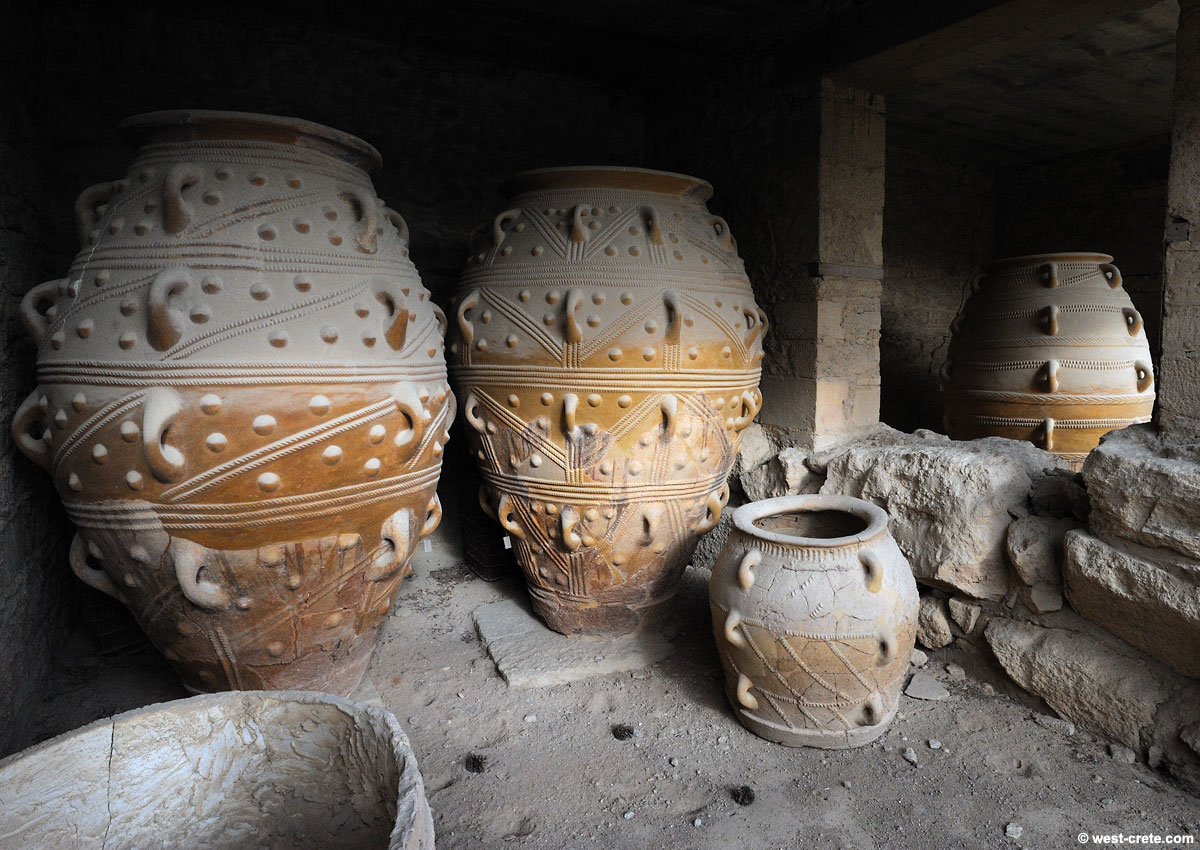
Pithos

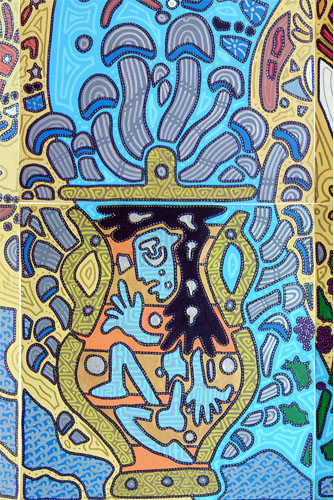
So I finally finished my devotional pithos!  I'm super excited about it.  

This is the product of decoupage and enamel paint (both new mediums for me), lubricated by plenty of wine and music.  The process was wonderful and turned out different than I expected. I will definitely try these mediums again... I like having glue under my fingers, smoothing out slippery god images...


It has images of all of the deites of the Thiasos of the Starry Bull, although Dionysos is a bit abstract - no direct images of him unless you count the child image of him with Hermes, or the Bull itself.  This abstraction felt right to me.  (I used an image of a female initiate from the Pompeii paintings for the heroines.)  I even managed to add an image of Estruscan Apollo at the last minute. 


Her Other, Blue-Grey Brother


The Myth


Apollodorus 3.3.1
... But Glaucus, while he was yet a child, in chasing a mouse fell into a jar of honey and was drowned. On his disappearance Minos made a great search and consulted diviners as to how he should find him. The Curetes told him that in his herds he had a cow of three different colors, and that the man who could best describe that cow's color would also restore his son to him alive. So when the diviners were assembled, Polyidus, son of Coeranus, compared the color of the cow to the fruit of the bramble, and being compelled to seek for the child he found him by means of a sort of divination. But Minos declaring that he must recover him alive, he was shut up with the dead body. And while he was in great perplexity, he saw a serpent going towards the corpse. He threw a stone and killed it, fearing to be killed himself if any harm befell the body. But another serpent came, and, seeing the former one dead, departed, and then returned bringing a herb, and placed it on the whole body of the other; and no sooner was the herb so placed upon it than the dead serpent came to life. Surprised at this sight, Polyidus applied the same herb to the body of Glaucus and raised him from the dead.
Minos had now got back his son, but even so he did not suffer Polyidus to depart to Argos until he had taught Glaucus the art of divination. Polyidus taught him on compulsion, and when he was sailing away he bade Glaucus spit into his mouth. Glaucus did so and forgot the art of divination.

Hyginus’ Fabulae [136] CXXXVI. POLYIDUS
When Glaucus, son of Minos and Pasiphae, was playing ball, he fell into a jar full of honey. In the parents’ search, they made inquiry of Apollo about he boy. Apollo told them: A prodigy has been born for you. Whoever explains it will restore the child to you. Upon hearing this reply, Minos began inquiring from his people about the prodigy. They told him that a bullock had been born which changed colour three times a day, every four hours - first white, then red, then black. Minos then called together the augurs to explain the prodigy, and when no one was found who could do so, Polyidus, son of Coeranus, showed that the bullock was like a mulberry tree, for first its fruit is white, then red, and when ripe, black. Then Minos said to him: “According to the words of Apollo, you should be able to restore my son to me.” While Polyidus was observing omens, he saw an owl sitting over the wine-cellar and putting bees to flight. He interpreted the omen, and brought out the lifeless boy from the jar. Minos said to him: “You have found the body. Now restore life to it.” When Polyidus said this was impossible, Minos ordered him to be shut in a tomb with the boy, and a sword placed there. When they had been shut in, a snake suddenly made for the body of the boy, and Polyidus, judging the creature whished to devour the body, suddenly drew the sword and killed it. Another snake, seeking its mate, saw that it was dead, and came and brought a herb, and its touch restored life to the dead snake. Polyidus did the same. When they called out from within, a passerby reported it to Minos, who opened the tomb and found his son safe. He sent Polyidus many gifts back into his country.

Robert Graves’ The Greek Myths
90c. Glaucus, while still a child, was playing ball one day in the palace at Cnossus or, perhaps, chasing a mouse, when he suddenly disappeared. Minos and Pasiphae searched high and low but, being unable to find him, had recourse to the Delphic Oracle. They were informed that whoever could give the best simile for a recent portentous birth in Crete would find what was lost. Minos made enquiries and learned that a heifer-calf had been born among his herds which changed in color thrice a day - from white to red, and from red to black. He summoned his soothsayers to the palace, but none could think of a simile until Polyeidus the Argive, a descendant of Melampus, said: ‘This calf resembles nothing so much as a ripening blackberry [or mulberry].’ Minos at once commanded him to go in search of Glaucus.
d. Polyeidus wandered through the labyrinthine palace, until he came upon an owl sitting at the entrance to a cellar, frightening away a swarm of bees, and took this for an omen. Below in the cellar he found a great jar used for the storing of honey, and Glaucus drowned in it, head downwards. Minos, when this discovery was reported to him, consulted with with the Curetes, and followed their advice by telling Polyeidus: ‘Now that you have found my son’s body, you must restore him to life!’ Polyeidus protested that, not being Asclepius, he was incapable of raising the dead. ‘Ah, I know better,’ replied Minos. ‘You will be locked in a tomb with Glaucus’s body and a sword, and there you will remain until my orders have been obeyed!’
e. When Polyeidus grew accustomed to the darkness of the tomb he saw a serpent, approaching the boy’s corpse and, seizing his sword, killed it. Presently another serpent, gliding up, and finding that its mate was dead, retired, but came back shortly with a magic herb in its mouth, which it laid on the dead body. Slowly the serpent came to life again.
f. Polyeidus was astounded, but had the presence of mind to apply the same herb to the body of Glaucus, and with the same happy result. He and Glaucus then shouted loudly for help, until a passer-by heard them and ran to summon Minos, who was overjoyed when he opened the tomb and found his son alive. He loaded Polyeidus with gifts, but would not let him return to Argos until he had taught Glaucus the art of divination. Polyeidus unwillingly obeyed, and when he was about to sail home, told Glaucus: ‘Boy, spit into my open mouth!’ Glaucus did so, and immediately forgot all that he had learned.
g. Later, Glaucus led an expedition westward, and demanded a kingdom from the Italians; but they despised him for failing to be so great a man as his father; however, he introduced the Cretan military girdle and shield into Italy, and thus earned the name Labicus, which means ‘girdled’.

Daniel Ogden’s Greek and Roman Necromancy
The Greeks used honey as a general preservative, and in particular made use of it when they wished to embalm their dead...  Other Greek traditions preserve a link between honey, resurrection, and necromancy. Thus the Cretan king Minos's son Glaucus disappeared and died by falling into a pot of honey. Polyidus ("the much seeing"), commissioned by the king to find him was led to the jar by a dream. Minos then ordered Polyidus to restore the boy to life, and, when he could not, had him immured with him in his tomb. A snake then brought and demonstrated a magic herb, which Polyidus used to resurrect Glaucus. The honey was evidently integral to the resurrection, for the summary proverb said, "Glaucus drank honey and rose again."

The Mushroom

Terrence McKenna’s Food of the Gods
Let us attempt to analyze this peculiar story. First of all, it is necessary to comment on the significance of the names of the two main characters: Polyidos is clearly “the man-who-has-many-ideas,” and Glaukos simply means “blue-gray”. The meaning of Glaukos was for me the entry point into the intention of the myth. It is well known among mycologists that the flesh of Stopharia cubensis and other psilocybin mushrooms has the property of staining a bluish color when bruised or broken. This blue staining is an enzymatic reaction and a fairly reliable indicator of psilocybin. Glaukos, the youth who is preserved in the jar of honey, seems symbolic of the mushroom itself…
    The antiseptic properties of honey have made it a preferred medium among many peoples for the preservation of delicate foods. And in Mexico honey has long been used to preserve psilocybin-containing mushrooms. The fact that Glaukos, the blue-gray one, fell into a honey pot...and was preserved there until the time of his resurrection seems highly suggestive. Herodotus mentions that the Babylonians preserved their dead in honey, and the use of large storage vessels, or pithoi, for burying the dead was widespread in the Bronze Age Aegean. The motif of cattle is present in the story in the bizarre section concerning the simile of the three-colored cow and the need to demonstrate linguistic facility as a precondition to being able to find the lost child. And the serpent, familiar from the Genesis story of Eden, makes a cameo appearance--and once again proves to have accurate and secret information concerning plants, especially plants that confer immortality. Polyidos, the shaman figure, uses the information gained from the serpent to return Glaukos to life; the information leaves Glaukos and returns to his departing teacher. This may refer to the elusive nature of the visions glimpsed during mushroom intoxication. […] all the motifs of a barely remembered mushroom cult are there--themes of death and rebirth, cattle, serpents with herbal knowledge, and a blue-gray child who is preserved in honey.

Bruce Rimell’s “Minoan Honey : The Bull, The Mushroom And The Mistress Of The Dance” (Essay & Accompanying Art)  

We also see here an explanation for Glaucos being the ‘son’ of the Minos-Asterion bull (or indeed of the Moon-Cow Pasiphae). As mycologists have pointed out, many psilocybin-bearing mushrooms are found naturally growing on the dung of cattle. The Minoans cannot have missed this important aspect of the plant’s culture – indeed this may have been how they or their Neolithic forebears discovered and cultivated this sacrament – and so encoded this detail into the myth as Glaucos son of the cow or bull. It is also noteworthy to consider that Glaucos has to enter the honey-pot, past the deathly owl and into the Underworld (the cellar), in order to transcend death. This resonates strongly with the honey given to the Mistress of the Labyrinth, suggesting the little son was only a sacrament once he had been transformed or preserved.

glaucos in the honey pot
“Glaucos” by Bruce Rimell

My Thoughts

My own introduction to Glaukos was through the above quoted book by Terrence McKenna, which also quoted Apollodorus in full.  I was quite stunned that this other brother of Ariadne had completely escaped my notice until then.  (Pretty sneaky of him.)  The second quoted source comes from an essay by Bruce Rimell which gets in-depth and speculative, but nonetheless fascinating reading.  He even provides a theory as to how Glaukos son of Minos might be connected to Glaukos the sea-god (who otherwise are very different characters, excepting the same name and both having a magical herb being a part of their stories.) If you look at nothing else in the essay, at least check out the artwork and the extensive photo essays after the bibliography.

Now, I want to highlight some observations and questions about the myth of Glaukos.

Polyidos: Did you catch that he was the descendant of Melampos?  I didn’t until recently, probably because Melampos was not strong on my radar until my involvement with the Thiasos of the Starry Bull, where he is recognized as one of the Dionysian heroes.  Melampos was also a seer and prophet, and spread the worship of Dionysos.  Both Graves and Hyginus note that Polyidos character was sometimes replaced with Asklepios.

Omens: The omen which leads Polyidos to the cellar is an owl frightening a swarm of bees. Although some versions gloss over this bit completely, Graves’ explains in his notes that the word for owl is “glaux”.  In other words, this is a pun for Glaukos name, and the bees symbolic of his falling into honey in the cellar on which the owl is perching.  (There could be double symbolism there in the owl being a bird of death/wisdom setting the bees [soul] to flight.)  I love this glimpse into the way that omens were interpreted back then.  I can’t recall if I’ve ever seen an omen that was a pun, which PROBABLY means I’m not paying enough attention.

Bees & honey:  A lot has been written about the importance of honey and bees in ancient Crete, and it is represented often in their art.  Honey was not just a food or commodity--it’s an immortal substance, a divine nectar, flowering nature itself, transformed into something entwined in both life and death.  Honey had medicinal and magical properties, could be a preservative or embalming agent, and could be transformed into intoxicating mead. There are sources that indicate that the Greeks thought of bees as souls and they were thought to be born from the carcasses of bulls--their other most sacred animal.  That Glaukos drowns in honey, and not in a pool of water or the ocean, would appear to point to some deeper symbolism here.  Dionysos has several associations with honey as well.

The color-changing calf:  Of all the details, this one seems most befuddling to the authors who provided possible interpretations to this myth.  But as these three colors together seem to crop up in shamanic and mystery traditions, it didn’t seem so strange to me.

Animals and plants:  This short myth has no less than 4 significant creatures in it. The calf, the owl, the bees and the snakes. And every single one is revealing some sort of knowledge.  And then there is the enigmatic, unidentified plant.  Was it unnecessary to identify it because it the plant itself was also one of its main characters?  Are these two snakes the same held by the Minoan snake goddess/priestess figures? Also noteworthy is the fact that the magical herb did not have to be ingested, simply placed on the body. But as Ogden mentioned in his book, it was not just the plant, it was also the honey that had restorative powers.

Resurrection:  In Greek mythology, Glaukos is one of the few people to be successfully returned from death to life.  Usually this required an actual journey by a god or hero to the Underworld.  And yet Polyidos is able to do this with just an herb revealed by a snake.  Hmmm….

More mushroom connections:  It’s a seemingly random detail, that Glaukos was eventually known for introducing a military girdle to Italy.  Unless he already had the nickname “girdled” and the detail tacked on later by way of explanation?  Maybe it’s a stretch, but it occurred to me that mushrooms have a skirt or girdle, called a ring or annulus, once the cap umbrellas out from the stem.  Rimell came to this same possible conclusion.  
    If Glaukos were a mushroom, consider the cycle it creates... one where a swarm of bees is born from the carcass of a bull, which goes on to create the sacred honey, which can be used to preserve the mushrooms, which themselves grow from the dung of cattle.  Another bit of Greek lore about mushrooms is that they were formed from lightning or thunderbolts hitting the ground, so that mushrooms are somehow connected to a Dionysian cult is perhaps not too far-fetched.


As much as I adore the idea of connecting my enthusiasm for mushrooms to my devotion to Dionysos, Ariadne and the whole bull mythos, I’m not entirely convinced Glaukos is a mushroom personified.  Regardless, I have this special fondness for his myth (what survives of it) and its mysterious implications.  Eventually I hope to share some UPG about Glaukos, but I didn’t want to go longer without introducing him, especially since my fascination of him goes back a couple years.  My husband and I went down the rabbit hole of this myth together in the year before his death.  So, I’ll leave you with a poem he wrote.


SONICRY

The only one who could ever teach me
was a blue honey-soaked son
He sighed like a maiden and held me like a mother
crooned a crone’s crow
a staggering echoing song
soaked me to the soul
He laid claims to the plains where every bull stamped its hoof
He lived under the trees of the forest floor
Glaukos son of Minos
brother of Dionysos
I hear your eyes when they are open
I feel your mouth when it’s closing
You’re closing in on me
My mouth fills with energy
I drown in your honey


Wednesday, May 14, 2014

-WANTED-


**Devotees of Dionysos**

Have you always been an outsider?  Someone who sees things differently?
Feeling stifled in your career?  Ready to shake up your life?
Do you value freedom above all else? 
This is the job for you!
Open to men, women, and any persons other or between
Near infinite number of positions available in a variety of divisions and branches, both traditional and innovative - your unique talents are needed!

Applicants should be foolhardy, visionary, willing to bend and break rules and
go beyond their comfort zones.

Must be willing to endure occasional (sometimes extreme) physical demands
Including but not limited to dance, fasting, ingestion of mind-altering substances, extreme art, little and big ego deaths.
Outdoor work will be necessary!
Very flexible hours!  Design your own schedule!

No health benefits or life insurance,
however other benefits may be available on a case by case basis,
depending on your perspective and the discretion of management. (Can be generous.)
Ask about our exclusive afterlife plans!

Criminal history? Mental health issues? Identity or mid-life crisis? No problem!

Willingness to travel or relocate is a plus,
as is a willingness to lose everything.
New devotees must give away their heart to the god on the first day.

What are you waiting for?  Act now to take advantage of this mythic opportunity.

Please Inquire Within!

[Printed on the side of a bottle.]


Tuesday, May 13, 2014

She rambles

In time. all time, I hate my Bakkhos, love my Bakkhos. I am lost in the counting of his moments, and report in slow detail to him that which happens in a flash. I see a love before me, not mine, though, for I have found no life in this body. Body? Dare I call it such? Lashed to the god by his word, his lips forming his pain and play like a song, and I spit it back at him, loving my Bakkhos, my god.


                                                     -- Frenzy by Percival Everett

Late night bath after Persephone's devotional day.  I throw in a handful of dittany of crete, some florida water, some floral bpal perfume.  Smear honey on my face, because why not?  Sip ale and read the first half of Frenzy by Percival Everett.  An incredible book, thus far, and no doubt my favorite Dionysian novel.  I stop now and then to ice my the tendons of my arm. The simplest remedies always take me the longest to get around to, for some reason.  Though it makes me writhe, I don't take it off my skin until it stops hurting.  It's all brain signals anyway. I have bruises on my leg that I'm not sure where they came from.


I imagine that I stay in the bath until dawn.  I do.


It's the eve of the anniversary of my husband's death.  Sometimes I worry, more than I care to admit, that death is like a drug trip.  Yet this doesn't stop me from tripping.  I imagine that similar fears of life and death have not stop me from being reborn.   I once, on the last solstice we had together, asked my husband about this after dancing the delta mary tango and forgetting the meaning of words. "Dionysos."  "Sunrise."  "Solstice."  They had shape and significance but my own loss of self could not reconcile their amorphousness.  I came back and said, "Are you still here?"  He said, "Yes, I'm here."  I said, "I wonder if that's what death is like."  He thought about that for a moment and said, "I don't think so."  We talked about it a little more, as I marvelled at glowing webs of energetic thread and color still pulsing around the room.  


In the bath, I take very deep breaths and it makes my heart beat abnormally hard and fast, in series of five.  I repeat this a few times with the same results.  No pain though, just a heart like a drumbeat and a penchant for unlucky numbers.  Maybe I'll die of a broken heart.  Or bad puns?


I think about Dionysos and whether all who love him are bound in some way, needing to be free.  Or sharing some other commonality of person or pattern that fits to His own.  I mean, everyone needs freedom from something, but for us... is it the willingness to forsake boundaries, the realization that such chains are there, an abnormal awakeness, a divine contract?  My given name actually means "bound".  I suppose it figures.  Such clues are everywhere if you look.


I found myself thinking a moon cycle or more back, about certain way I thought I might hold myself back.  (a la "I don't think I could ever...") Which isn't always wrong, I mean sometimes there are taboos and I thought perhaps I had found one.  Dionysos disabused me of that notion pretty quick, with a loud "I'm sending you a dream." And he did, and he made his point.  I think the point was the point, so far.  At least, in other words, actual circumstances have not tested me... I think he just wished me to drop that idea pretty quick.


If you want to go mad, you need to give yourself more time with your own thoughts.  Truth.  


I have been chanting a lot lately, the Greek words from the bone tablets.  Particularly...


Bios Thanatos Bios Alethaia Zagreus Dionysos


Sometimes when I'm walking outside, sometimes at odd moments when I'm alone.  I'm quite enamored with the way they flow off the tongue.


Bios Thanatos Bios Alethaia Zagreus Dionysos


Sleep overtakes me.  I shan't apologize for being strange.